public final boolean sendMessage(Message msg) { return sendMessageDelayed(msg, 0); }
public final boolean sendEmptyMessage(int what) { return sendEmptyMessageDelayed(what, 0); }
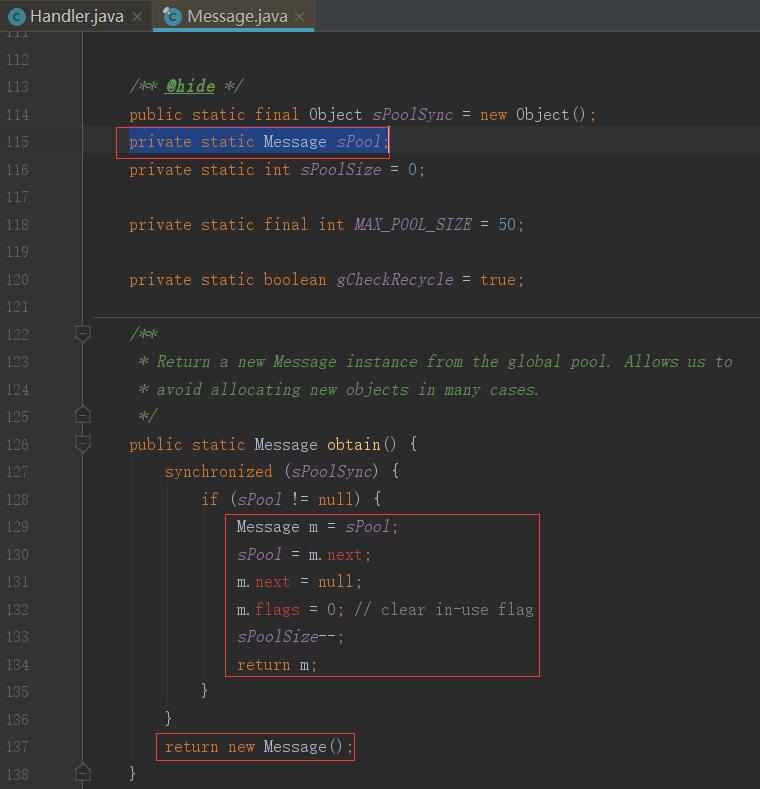
public final boolean sendEmptyMessageDelayed(int what, long delayMillis) { Message msg = Message.obtain(); msg.what = what; return sendMessageDelayed(msg, delayMillis); }
public final boolean sendEmptyMessageAtTime(int what, long uptimeMillis) { Message msg = Message.obtain(); msg.what = what; return sendMessageAtTime(msg, uptimeMillis); }
public final boolean sendMessageDelayed(Message msg, long delayMillis) { if (delayMillis < 0) { delayMillis = 0; } return sendMessageAtTime(msg, SystemClock.uptimeMillis() + delayMillis); }
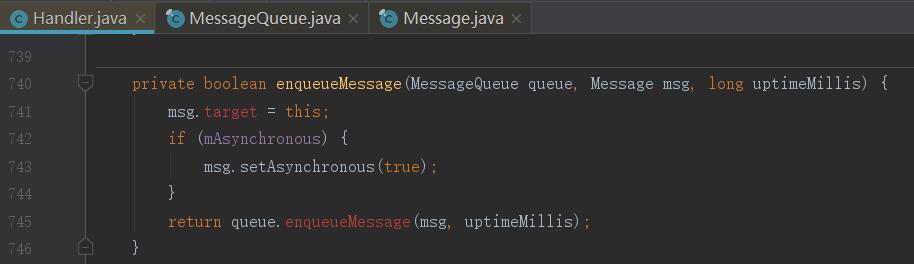
public boolean sendMessageAtTime(Message msg, long uptimeMillis) { MessageQueue queue = mQueue; if (queue == null) { RuntimeException e = new RuntimeException( this + " sendMessageAtTime() called with no mQueue"); Log.w("Looper", e.getMessage(), e); return false; } return enqueueMessage(queue, msg, uptimeMillis); }
public final boolean sendMessageAtFrontOfQueue(Message msg) { MessageQueue queue = mQueue; if (queue == null) { RuntimeException e = new RuntimeException( this + " sendMessageAtTime() called with no mQueue"); Log.w("Looper", e.getMessage(), e); return false; } return enqueueMessage(queue, msg, 0); }
boolean enqueueMessage(Message msg, long when) {
    if (msg.target == null) {
        throw new IllegalArgumentException("Message must have a target.");
    }
    if (msg.isInUse()) {
        throw new IllegalStateException(msg + " This message is already in use.");
    }

    synchronized (this) {
        if (mQuitting) {
            IllegalStateException e = new IllegalStateException(
                    msg.target + " sending message to a Handler on a dead thread");
            Log.w(TAG, e.getMessage(), e);
            msg.recycle();
            return false;
        }

        msg.markInUse();
        msg.when = when;
        Message p = mMessages;
        boolean needWake;
        if (p == null || when == 0 || when < p.when) {
            // New head, wake up the event queue if blocked.
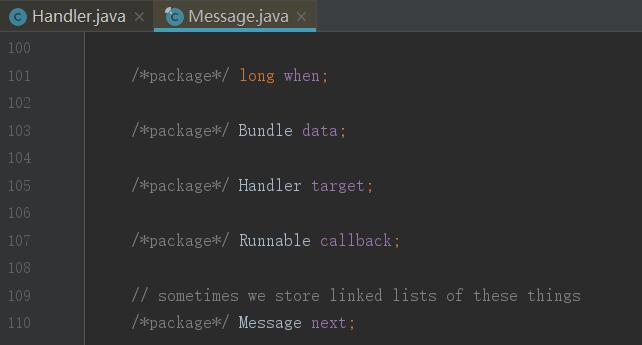
            msg.next = p;
            mMessages = msg;
            needWake = mBlocked;
        } else {
            // Inserted within the middle of the queue.  Usually we don't have to wake
            // up the event queue unless there is a barrier at the head of the queue
            // and the message is the earliest asynchronous message in the queue.
            needWake = mBlocked && p.target == null && msg.isAsynchronous();
            Message prev;
            for (;;) {
                prev = p;
                p = p.next;
                if (p == null || when < p.when) {
                    break;
                }
                if (needWake && p.isAsynchronous()) {
                    needWake = false;
                }
            }
            msg.next = p; // invariant: p == prev.next
            prev.next = msg;
        }

        // We can assume mPtr != 0 because mQuitting is false.
        if (needWake) {
            nativeWake(mPtr);
        }
    }
    return true;
}
public Handler(Callback callback) { this(callback, false); }
public Handler(Looper looper) { this(looper, null, false); }
public Handler(Looper looper, Callback callback) { this(looper, callback, false); }
public Handler(boolean async) { this(null, async); }
public Handler(Callback callback, boolean async) { if (FIND_POTENTIAL_LEAKS) { final Class<? extends Handler> klass = getClass(); if ((klass.isAnonymousClass() || klass.isMemberClass() || klass.isLocalClass()) && (klass.getModifiers() & Modifier.STATIC) == 0) { Log.w(TAG, "The following Handler class should be static or leaks might occur: " + klass.getCanonicalName()); } }
mLooper = Looper.myLooper(); if (mLooper == null) { throw new RuntimeException( "Can't create handler inside thread " + Thread.currentThread() + " that has not called Looper.prepare()"); } mQueue = mLooper.mQueue; mCallback = callback; mAsynchronous = async; }
/**
 * Run the message queue in this thread. Be sure to call
 * {@link #quit()} to end the loop.
 */
public static void loop() {
    final Looper me = myLooper();
    if (me == null) {
        throw new RuntimeException("No Looper; Looper.prepare() wasn't called on this thread.");
    }
    final MessageQueue queue = me.mQueue;

    // Make sure the identity of this thread is that of the local process,
    // and keep track of what that identity token actually is.
    Binder.clearCallingIdentity();
    final long ident = Binder.clearCallingIdentity();

    // Allow overriding a threshold with a system prop. e.g.
    // adb shell 'setprop log.looper.1000.main.slow 1 && stop && start'
    final int thresholdOverride =
            SystemProperties.getInt("log.looper."
                    + Process.myUid() + "."
                    + Thread.currentThread().getName()
                    + ".slow", 0);

    boolean slowDeliveryDetected = false;

    for (;;) {
        Message msg = queue.next(); // might block
        if (msg == null) {
            // No message indicates that the message queue is quitting.
            return;
        }

        // This must be in a local variable, in case a UI event sets the logger
        final Printer logging = me.mLogging;
        if (logging != null) {
            logging.println(">>>>> Dispatching to " + msg.target + " " +
                    msg.callback + ": " + msg.what);
        }

        final long traceTag = me.mTraceTag;
        long slowDispatchThresholdMs = me.mSlowDispatchThresholdMs;
        long slowDeliveryThresholdMs = me.mSlowDeliveryThresholdMs;
        if (thresholdOverride > 0) {
            slowDispatchThresholdMs = thresholdOverride;
            slowDeliveryThresholdMs = thresholdOverride;
        }
        final boolean logSlowDelivery = (slowDeliveryThresholdMs > 0) && (msg.when > 0);
        final boolean logSlowDispatch = (slowDispatchThresholdMs > 0);

        final boolean needStartTime = logSlowDelivery || logSlowDispatch;
        final boolean needEndTime = logSlowDispatch;

        if (traceTag != 0 && Trace.isTagEnabled(traceTag)) {
            Trace.traceBegin(traceTag, msg.target.getTraceName(msg));
        }

        final long dispatchStart = needStartTime ? SystemClock.uptimeMillis() : 0;
        final long dispatchEnd;
        try {
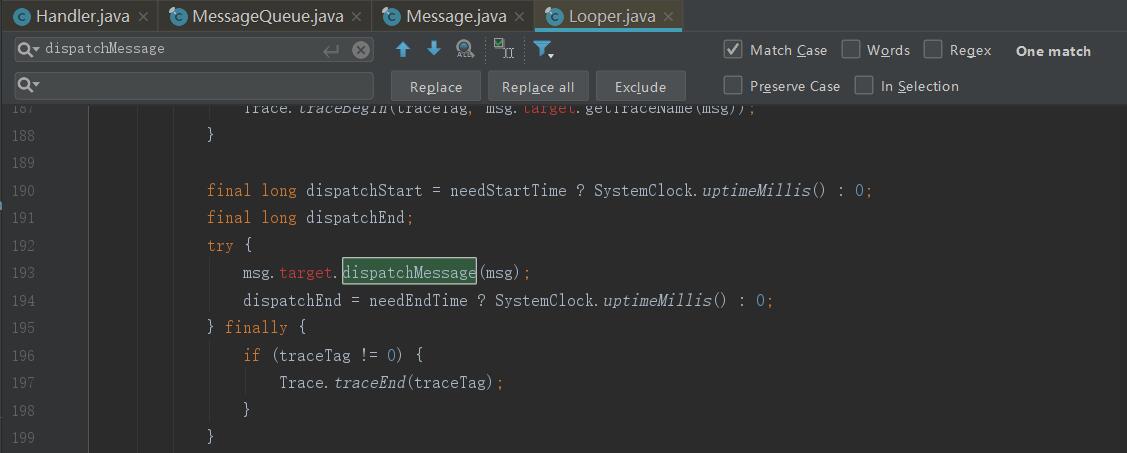
            msg.target.dispatchMessage(msg);
            dispatchEnd = needEndTime ? SystemClock.uptimeMillis() : 0;
        } finally {
            if (traceTag != 0) {
                Trace.traceEnd(traceTag);
            }
        }
        if (logSlowDelivery) {
            if (slowDeliveryDetected) {
                if ((dispatchStart - msg.when) <= 10) {
                    Slog.w(TAG, "Drained");
                    slowDeliveryDetected = false;
                }
            } else {
                if (showSlowLog(slowDeliveryThresholdMs, msg.when, dispatchStart, "delivery",
                        msg)) {
                    // Once we write a slow delivery log, suppress until the queue drains.
                    slowDeliveryDetected = true;
                }
            }
        }
        if (logSlowDispatch) {
            showSlowLog(slowDispatchThresholdMs, dispatchStart, dispatchEnd, "dispatch", msg);
        }

        if (logging != null) {
            logging.println("<<<<< Finished to " + msg.target + " " + msg.callback);
        }

        // Make sure that during the course of dispatching the
        // identity of the thread wasn't corrupted.
        final long newIdent = Binder.clearCallingIdentity();
        if (ident != newIdent) {
            Log.wtf(TAG, "Thread identity changed from 0x"
                    + Long.toHexString(ident) + " to 0x"
                    + Long.toHexString(newIdent) + " while dispatching to "
                    + msg.target.getClass().getName() + " "
                    + msg.callback + " what=" + msg.what);
        }

        msg.recycleUnchecked();
    }
}
我们先翻译一下这个 Looper.loop 方法的注释
Run the message queue in this thread. Be sure to call  {@link #quit()} to end the loop.
在这个线程中运行消息队列。确保调用{@link #quit()}来结束循环。
// This must be in a local variable, in case a UI event sets the logger final Printer logging = me.mLogging; if (logging != null) { logging.println(">>>>> Dispatching to " + msg.target + " " + msg.callback + ": " + msg.what); }
final long traceTag = me.mTraceTag; long slowDispatchThresholdMs = me.mSlowDispatchThresholdMs; long slowDeliveryThresholdMs = me.mSlowDeliveryThresholdMs; if (thresholdOverride > 0) { slowDispatchThresholdMs = thresholdOverride; slowDeliveryThresholdMs = thresholdOverride; } final boolean logSlowDelivery = (slowDeliveryThresholdMs > 0) && (msg.when > 0); final boolean logSlowDispatch = (slowDispatchThresholdMs > 0);
final boolean needStartTime = logSlowDelivery || logSlowDispatch; final boolean needEndTime = logSlowDispatch;
if (traceTag != 0 && Trace.isTagEnabled(traceTag)) { Trace.traceBegin(traceTag, msg.target.getTraceName(msg)); }
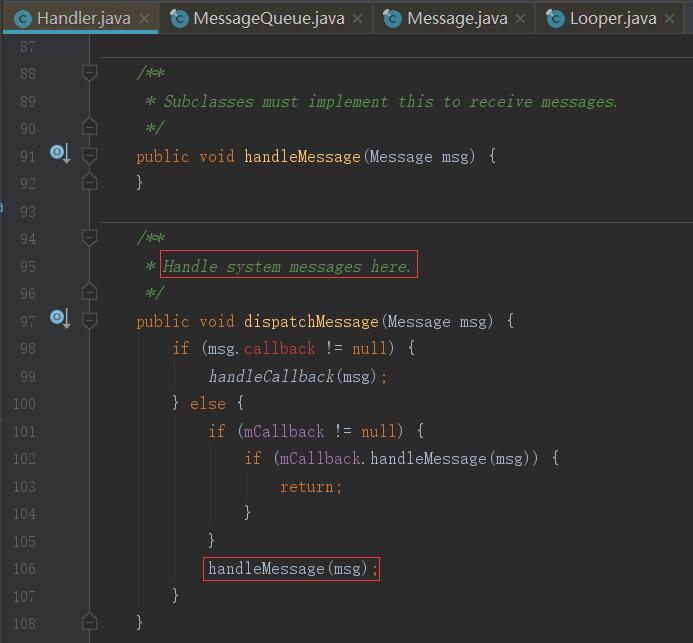
final long dispatchStart = needStartTime ? SystemClock.uptimeMillis() : 0; final long dispatchEnd; try { // msg.target 之前说过了,在 sendMessage 的时候已经赋值自身给这个字段了 msg.target.dispatchMessage(msg); dispatchEnd = needEndTime ? SystemClock.uptimeMillis() : 0; } finally { if (traceTag != 0) { Trace.traceEnd(traceTag); } } }